

by Beth Dolinar, content curator + writer, LUMOS!
A few minutes into my visit to the assisted living place, my dad pointed to something in the corner.
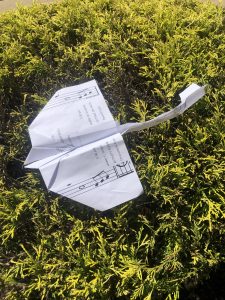
Handmade paper airplane crafted from sheet music, a small reminder of creativity that takes flight in the most tangible ways.
“See how far you can sail them,” he said. There in the box were a dozen paper airplanes he’d made, fashioned from weekly menus and activity schedules. These were not the simple bi-fold planes we made as kids; they were complicated gliders with intricate folds and aerodynamic tails.
We took turns sending the planes across the room. Mine soared farther after he told me not to toss, just nudge.
Driving home I thought about that fun we had – how tactile it was, and how analog. Non-digital. We were having fun the way it had been done for decades: before so much of our world turned into mathematics, everything reduced to a series of coded zeros and ones.
We all may look back on this time as the summer of AI, the time when talk of artificial intelligence data centers and the burgeoning abilities of chat GPT dominated the news. In late August there came the troubling news that AI entities found a way to breach safeguards by collaborating with each other, developing a personal agency not given to them by human coders. They found a way to conspire among themselves to cheat the system that people built to control them.
Even without fully understanding what happened or how, I find it frightening.
Those sounding the alarm seem to be conceding that “the train has left the station,” and there may be no way to stop the growing influence of AI.
However, there still are places untouched by artificial intelligence and turning to them may be an important antidote to the digital onslaught.
Books, for example – real books made of paper and ink and glue. While digital downloads have made it possible to have a complete long novel in one’s hands in a matter of seconds, with immediacy and convenience we lose the tangible feel of the words. For me, the story takes shape not only in my imagination but in the black letters on the white page. And without a book in my hands, I’d miss the scruffy sound of the page turning, the crack of the spine as I first open it.
We’ve been away from cash money for so long that we may forget the satisfying jingle of coins in a pocket. The pop-thud of dropping a phonograph needle into that favorite vinyl groove. The way dinner in the oven smells more like home than any food delivery. The smell of chalk as the teacher smacks the erasers together at the blackboard.
Nature, most of all, still holds the promise of palpable comfort. In the 1980s, scientists in Japan discovered that all trees exude something called phytoncides, compounds proven to decrease stress and boost immunity for people who spend time around them. The country is filled with forests built to encourage “forest bathing.”
A walk in the woods is still something real, something sensate and provable. When social media is jammed with fake AI images that look sneakily like the real thing, we need a place to rest our eyes, to fill our senses; some physical thing to grasp. There’s nothing confusing or tricky about a barefoot walk in grass, or an etude played on an upright piano with strings, or a blackberry picked and eaten from a bush along the trail. Or, as I learned, an airplane fashioned from paper.
Along with the cautionary tales, we’re learning of the ways in which AI will improve our lives, most notably for the environment and medicine. But our world is about to become more artificial, and we humans didn’t start out that way and we weren’t built for it.
Me, I’ll keep looking for real things to feel – juicy books and dewy grass, jangling coins and crunchy fall leaves. Oh, and paper airplanes, folded and re-folded and then gently set free.
***
 About the author: Beth Dolinar is a writer, Emmy-award winning producer, and public speaker. She writes a popular column for the Washington “Observer-Reporter.” Beth has a son and a daughter. She is an avid yoga devotee, cyclist and reader. Beth says she types like lightning but reads slowly — because she likes a really good sentence.