

by Beth Dolinar, content curator + writer, LUMOS!
Band nerd here.
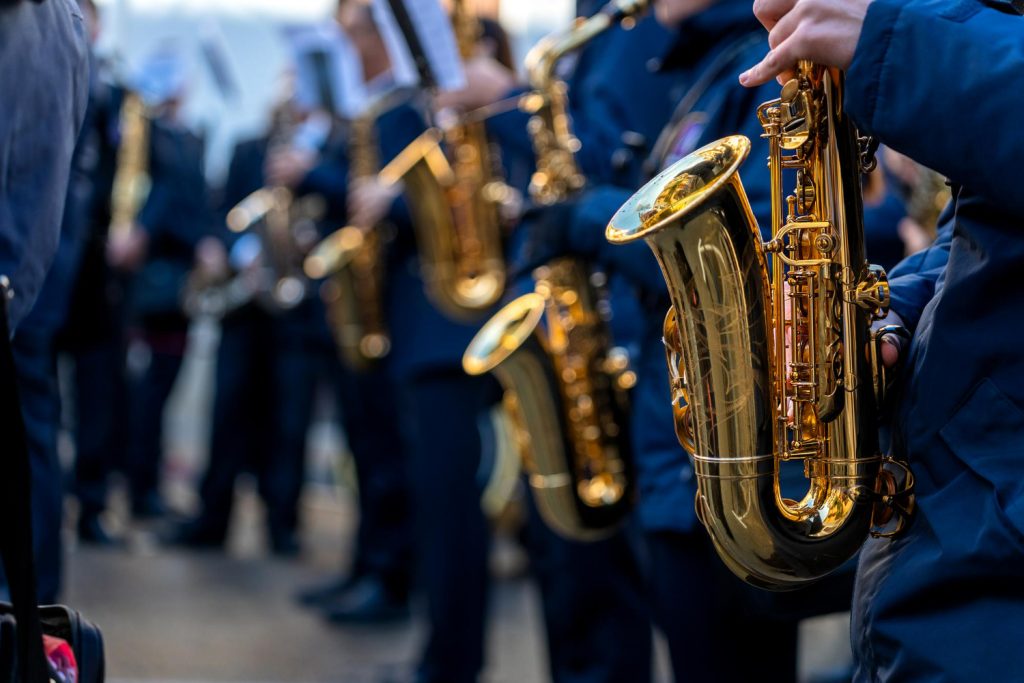
Although I haven’t picked up an alto saxophone in many years, the identity has a way of sticking. Back then, I was first-chair in my high school and college bands, soaking reeds and practicing sheet music through all the seasons. Winter and spring brought concerts and jazz performances; summer and fall meant football halftime shows and parades.
The nerd designation was mostly derogatory in the 1970s, but since then the shade has appropriately lifted. Somewhere along the way the nerds got their revenge and invented computers, and the band members took their place of honor on the halftime football field.
From the strutting and back-bending drum majors to the sousaphone dotting the “i” in Ohio State, college and university marching bands are magnificent. But in a wrongheaded move, few if any broadcasts of college games show the halftime band performances. By halftime, haven’t the viewers seen and heard enough of recaps, sports analysis and commercials?
You can catch video of the halftime shows on YouTube. This time of year, I fall into that rabbit hole because I marched on those fields and I’m the daughter of a college band director. Check out the Texas A&M halftime show: you’ll see maneuvers so breathtaking in their precision you’ll rewind and watch again, just figure out how they did that.
It is not easy keeping a straight line while maintaining tempo and playing the right notes. While my high school and college marching bands never attempted the complex formations of the top university bands, we graced the field with moving patterns. Those watching from the stands could make out an “R” or a “C” and maybe an arrow. My state college band was smaller and our routines simpler, but marching gave me the sense of being a little, but important, part of something bigger than I was.
That feeling of belonging is fundamental.
Even when we are young and don’t understand why, we reach for the connection. Sports teams provide it, as do clubs and charity work and singing in choirs. Sociologists talk about the “me” culture, and how we’ve become more self-centered and individualistic. And while the need for independence and self reliance will always be the tenet of a strong society, there’s just as much to be said for being a small shiny piece of a large mosaic.
Before the instant gratification of a smart-phone selfie, we rarely saw ourselves as others see us. Summers brought group family photos on the beach or in the back yard, and after the photos came back from the developer, we could get a glimpse of where we fit into the family picture.
But selfies have rendered us self-referential – alone in the frame without the context of the world around us. It’s an incomplete and probably flawed perspective, and it’s lonely.
All those Friday nights marching into the stadium, I knew my parents probably struggled to pick me out of the lineup. We were a sea of blue and gold uniforms and tall fuzzy hats. The spectators would not have heard those of us in the woodwind line yelling to “dress left” and “knees higher,” but there was plenty of yelling down there as we approached the fifty yard line.
And now these decades later, as so much of life becomes solitary, my memory returns to those moments. Seen from far above, I was just one of many. But down there on the field, the sound around me was bright and rich, and I was part of it.
I lifted my knees higher knowing that without me, that moment would not be the same. The band needed me, and I them.
***
 About the author: Beth Dolinar is a writer, Emmy-award winning producer, and public speaker. She writes a popular column for the Washington “Observer-Reporter.” Beth has a son and a daughter. She is an avid yoga devotee, cyclist and reader. Beth says she types like lightning but reads slowly — because she likes a really good sentence.